
Autonomy in Property Management
On each property managed, the typical manager oversees dozens of services required every year. Notwithstanding, unscheduled service requirements that emerge dynamically as events around ownership, operation and tenants unfold.
Technology remains inefficient here so the expense is based on time and manpower with initiation costs starting around $500 per service. The expense to manage execution is linear to the complexity of operations.
Organizing simple access to a property where tenants hire security might involve four independent organizations. It’s not unusual for the collective stakeholders to burn through $1,400 in manpower on scheduling alone. Data technology will reduce this expense to pennies.
Data originated in build may pass through management at any point between concept and operation.
Preserving the advantages of information require owners capture and store deep data in the cloud for long term utility.
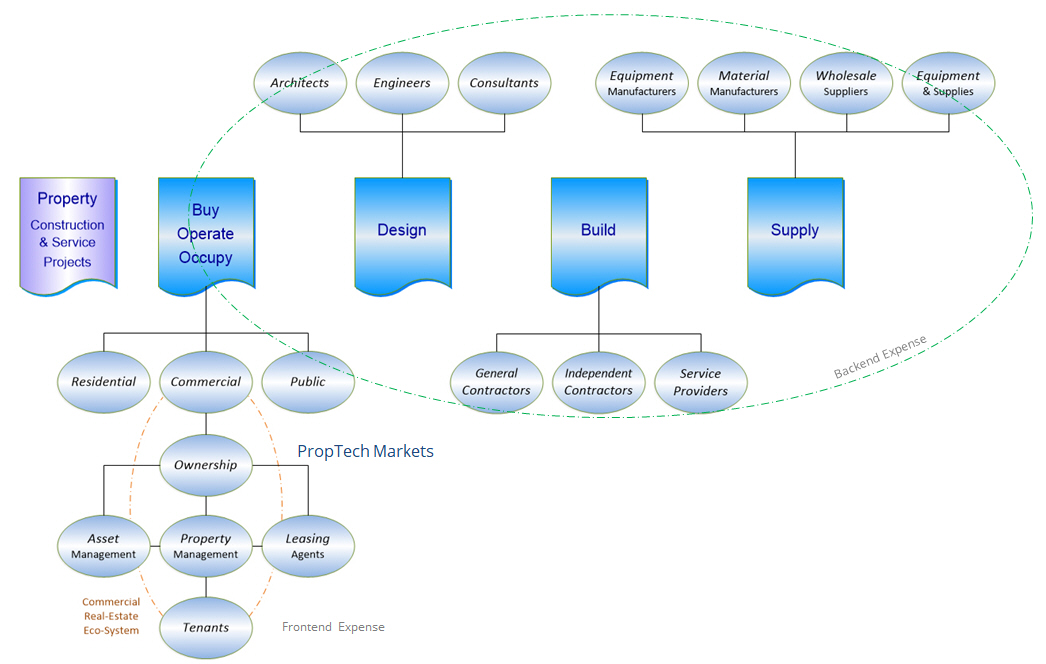
“property documentation is far from consistent between assets”
Managers must deal with large volumes of information, manually performing research, processing details and scheduling services for everything from lightbulb maintenance in parking lots to waterproofing.
Locating information, coordination and scheduling services are time consuming processes performed by diverse stakeholders who need distinct details. Managers are the logical go to source but impacts their workload and productivity. And current methods inevitably repeat with any change in personnel throughout the value chain.
Identifying property specific detail continues to require manual review of documentation that is far from consistent between assets under management. Artificial intelligence can assist in searching computer files but adds expense, a technology step and user process.
Air-gapped computer files must be searched repeatedly by every user, platform or technology of different stakeholders that need information. Deep data on a property is mostly static detail but require periodic updates and uploads. Today, many building systems produce data dynamically.
Capturing equipment data in the cloud eliminates the need for service providers to download the details onsite. Management, contractors and tenants will recover valuable manpower, reduce local traffic and tenant disruption.
Converting computer files that detail property assets, structures and grounds to simple data pairs minimize storage cost and improves its analytic value. Securing deep data in the cloud expands accessibility, transparency, portability and its utility. This allows service provider AI to enhance user and process efficiency through technology built for their fields of expertise.
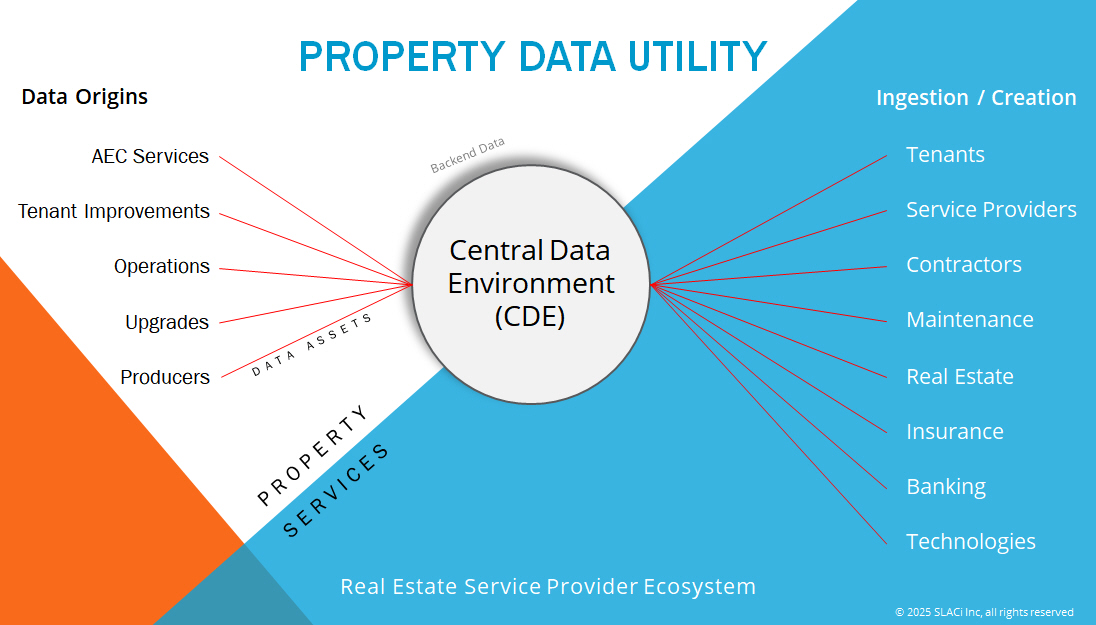
These data libraries are central to autonomous and transparent exchange of data constants between stakeholders and organizations via technology.
“Transitioning build data into enterprise grade AI data provide benefits and technology advantages throughout the value-add service chain”
Data Foundations
Cloud positioned data establishes a foundation for autonomy between independent data libraries, technology platforms and isolated ecosystems. The digital transformation of property is to complete the digitization of industry where property, service providers and vendors recognize and manage their data as an AI Data Library.
This information is agnostic to technology and details how a company’s AI implements autonomy and data exchange between data centric platforms. These independent libraries provide a central location for everything from detail and instructions to protocols for data exchange internally and through external communications.
The following are some examples of how AI Data Libraries will be used in practical applications of management autonomy.
Budget Forecasting
The property management library allow tech used by managers to initiate data exchange in the background through normal user processes. Autonomy transforms routine manual tasks to achieve consistent time saving results.
Budget forecasting and updating service provider rates for next year is a great example. This remains a manual task that both managers and contractors repeat annually for multiple service providers and clients respectively.
The vendors personalized AI data library offer a secure reliable source and single point of entry to update annual rate data. The client’s (management) AI data library provides a central point of access for the managers technology to obtain applicable current and house or upcoming rate changes.
Interoperable technologies authenticate the service provider-client relationship and autonomously exchange data without additional user steps, technology or accounts. The data request is initiated within the budget forecasting process and cascades throughout the service provider ecosystem.
Management technology will query service provider data as necessary. If a future rate is not available, the service provider technology will advise the admin of a pending request and process any anticipated change.
Integrated objectives initiate autonomy between diverse technologies operating on independent data to achieve common goals.
Agentic AI Scheduling
Agentic AI scheduling agents will be the backbone of user applications in many industry sectors and segments. Schedule autonomy will be the holy grail that makes us feel like we’re living in the future. Personal technologies, company data and agentic AI will be capable of handling 85% of all scheduling activity within five years of industry embracing AI data and digital exchange.
This is one area where property managers act as liaison for the entire property value chain and service provider ecosystems. Its an environment where any stakeholder can initiate the necessity to coordinate property access or deliverables involving multiple interests. And, it’s one of the most time consuming task in the industry.
Scheduling AI will reduce “tentative” to a data queue of matching variables returned in seconds. Generally and on the surface of exchange between firms, users will be able to select or introduce a preferred date-time. But anyone can accept matching defaults and automatically add items to their mobile and desktop calendar’s.
Below the surface, AI scheduling agents will be used to dispatch personnel and arrange supply chain deliverables. Integrated into contractor project management technology autonomy will schedule where personnel need to be in real time. A combination of platforms and mobile apps will use to analyze and match personnel to field work.
Scheduling agents will connect client and tenant maintenance requests to service providers and personnel in the field. A roofer will repurpose installation activities to leak repairs or reroute HVAC personnel when weather precipitates a change.
Daily schedules will be automatically updated in both our mobile and desktop devices with real time notification for field personnel and activities.
COI Processing
Request for COI and AIE documents is a standard practice throughout the industry. PropTech attempts to process these request autonomously but autonomy stops at the requesting authority (technology) of its user.
The result has been vendors spending up to 16 hours of disruptive manpower to process a single COI or AIE request through PropTech. It may be one of the easiest workflows to automate but its also one of the most complicated data flows between diverse interests and stakeholders.
Real estate embraces various types and standards for insurance including deviations, special instances and exceptions to requirements but relies on variations of boilerplate terms developed over time. Terms that get handed down from individual interest in finance, owners and developers to build, management, service providers and supply chains.
Boilerplates that served their purpose in the analog universe will eventually be replaced by dynamic data customized to established thresholds. Data libraries throughout the value chain will describe and reconcile insurance thresholds on an individual basis. SLACi digital identities provide a foundation for the anonymous technologies of these trusted users to communicate in the background.
The managers platform will process requests on-demand by initiating a vendor query which in turn exchanges data with its insurance agents’ technology to fulfill deliverables. The independence of AI data simplifies the same process in AEC, build, general contractors and others who provide construction and project management.
Information to process a COI or AIE will reside inside the personal AI data libraries of property and organizations throughout the industry. Today, user technologies can collaborate to process insurance documents on-demand but shared industry objectives will transition these analog deliverables to digital bytes within ten years.
See how it works!
Conclusion
Digitizing property operation is a community effort towards industry efficiency. A mutual objective in recognizing the manual process in terms of digital transparency and exchange of data between property, independent service providers, organizations and supply chains to achieve common goals.
Incremental Implementation
Implementing tangible autonomy in real estate will occur in small steps proportionate to the availability of data and off-the-shelf solutions. Data is the precursor and least expensive technology to assemble. Its the next step to facilitate development of AI technologies that integrate industry workflows.
SLACi provides infrastructure and digital signatures for owners and management to seamlessly connect real estate industry data, users and technology. Our data technologies help data owners convert their private details into enterprise grade AI data with secure cloud accessibility.
Join our live discussions!
More about data:

AI Data Library Intro
Real estate spans eight industry sectors so what an AI data library may contain depends on use case and sector. A property data library begins with secure accessibility to the property information model (PIM).

Best Storage for Property Data and Owners
Every property has its own AI data library that should be stored in the cloud but what type of storage offers the highest advantage to property owners, investors and service provider ecosystems.

Digital Data Benefits for NNN Owners
Five key reasons why NNN property owners should adopt a digital data policy. This article discusses AI, data utility and taking ownership of property data as an investment.